Define performance
Agree what people, teams or the organisation need to do better, and why it matters.
Key questionWhat should be different in the real work?
Systems Approach to Training
SAT helps organisations avoid jumping straight to a course. It starts with the required performance, examines the whole working system, designs the right response and keeps evaluation and improvement active throughout.
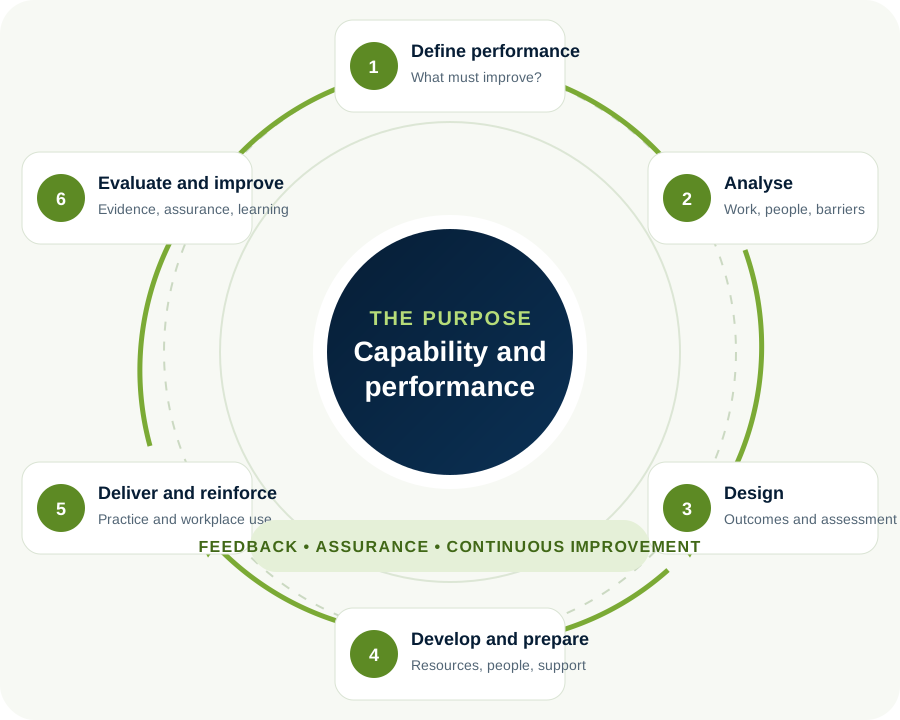
SAT is not a grand name for producing more training paperwork. It is a way to make sure the solution is needed, usable, supported and capable of improving performance.
The approach is grounded in the same disciplined logic associated with ADDIE, while making the wider system, assurance, feedback and continuous improvement more visible. It recognises that learning succeeds or fails in the workplace, not in the course catalogue.
This page is a practical web adaptation of the approach discussed in my book. It is not an official Ministry of Defence or JSP 822 diagram.
The practical cycle
Each stage informs the others. New evidence can send the work backwards, forwards or around the cycle again.
Agree what people, teams or the organisation need to do better, and why it matters.
Key questionWhat should be different in the real work?
Examine tasks, audience, standards, current capability, working conditions and the barriers to performance.
Key questionIs the gap really caused by knowledge or skill?
Set clear outcomes, practice, assessment, accessibility and the route from learning to application.
Key questionWhat must learners be able to demonstrate?
Build and test resources, prepare facilitators and managers, and make the learning environment ready.
Key questionWhat has to be in place before delivery?
Create practice, feedback and support during delivery, then reinforce application through the workplace.
Key questionWhat will help the new behaviour survive?
Use learner, manager and operational evidence to assure quality, improve the response and challenge weak assumptions.
Key questionWhat evidence shows that performance improved?
Why use a systems approach?
“We need training” becomes a starting hypothesis, not a pre-agreed answer.
Process, tools, workload, manager behaviour and reinforcement are considered alongside learning.
Practice, job aids, feedback and first application are planned rather than left to chance.
Evaluation is used to improve decisions, not simply to decorate a report with attendance figures.
Practical example
The course-first response is to send everyone through the module again. A systems approach pauses and examines the evidence.
Performance: Which errors continue, where and with what consequence?
Analysis: Is the cause recall, a confusing form, workflow design, poor access or lack of manager reinforcement?
Response: Combine targeted learning with prompts, a job aid, manager briefing and workflow improvement.
Evidence: Track fewer repeat errors, correct application and confidence at the point of work.
A method from my book
Making Sense of Organisational Development and Learning connects learning decisions with systems, capability and impact.
The value of SAT is the discipline of asking the right questions in the right order. The level of documentation should be proportionate to the risk, scale and complexity of the work.
Start with the performance requirement. Keep testing the system. Improve what the evidence tells you to improve.
Could you explain the performance problem without using the word “training”?
Experience behind the method
My foundations in systems-based training were developed through British Army leadership and training roles, including work aligned with Defence Systems Approach to Training principles.
I have since applied the same disciplined habits across global financial services, operational environments and local government: diagnose before designing, connect learning to performance, assure quality and keep improving.
Start a conversation
Tell me what has been requested, what needs to improve and what evidence you already have. I can help you work through the problem before time and budget are committed to the wrong answer.